

The first plants to pop up in the spring tend to have properties that help us feel less puffy and get things moving, with supportive action to open our detoxication pathways and make our skin glow again. Right on time to help us feel our best for the warmer weather ahead! Despite what’s been going on outside and the fact that yes its almost tax day and we still have snow on the ground in Northern Wisconsin, I’m still holding on tightly that in one month we’re all going to be outside frolicking in our gardens harvesting three of my most loved spring time herbs ... right!?
So, while we wait for warmer temps, I am going to introduce you to three common and abundant springtime herbs that you likely already see in a variety of your herbal-based skincare and natural wellness products. I’ll walk you through some oftheir key actions, why they might be for you to support this transition from winter to spring, what to look for when it comes to choosing products, and how you try them in recipes at home- from your own backyard!
But first, a little disclaimer...
This is shared for educational purposes to support your understanding of herbs and wellness. It is not medical advice; it is not intended to diagnose, treat, or cure. If you have specific health concerns, are pregnant, nursing, or taking medications, it’s always wise to check with a trusted healthcare provider.
Now back to the fun stuff...
Dandelion for moving stagnation and reviving that springtime glow

The first herb I want to introduce you to is Dandelion, Taraxacum officinale. If we’ve ever been sold a sack of lies about a plant, the dandelion is it. I say this because for many of us, we’ve been convinced that the dandelion is nothing more thanan annoying weed that must be removed from our manicured lawns. The truth is, it is an absolute superstar when it comes to liver, colon, and kidney health. It’s incredibly nutritious, edible from top to bottom, boasting a wide range of vitamins and minerals that nourish our systems deeply, and contains carotenoids that quite literally make our skin glow. And it grows virtually anywhere and everywhere.
While every part of the plant is useful for medicine or food, in the springtime, it’s the tender leaves and bright colored flower heads that we are after. You could technically harvest the roots in the spring, but they are much better in the fall when they’ve had a chance to pull up all the essential minerals and develop gut-supportive inulin after the long growing season.

The sweet tasting flowers contain the carotenoid lutein, which is incredibly supportive of eye health. The flowers and tender leaves can be used in tea, sautéed, or eaten raw. Although bitter, they are excellent for stimulating digestion and getting things moving again after a winter of heavy meals.
Dandelion tea is one of the easiest ways to start enjoying this plant. You can use fresh or dried leaves and flower parts. A warm cup mid-morning or between meals in the afternoon can gently support digestion and help your body wake up after the slower pace of winter.
When it comes to skincare, many herbalists will pick and dry the flower heads and infuse them in carrier oils to make a carotenoid rich infusion which helps bring back a healthy natural glow to dull or ashy skin. Dandelion infused oil can also help calm irritated skin and offers gentle antioxidant protection.
The mineral-rich leaves act as diuretic and slight astringent, moving lymph and fluids through our systems, gently detoxing our kidneys and blood. They are rich in vitamins A, C, and K, as well as trace minerals, especially potassium.
Plantain for gentle skin and wound healing, bites and digestives woes.

The next springtime herb we are going to talk about is one of my most-loved herbs because of how versatile and abundant it is, plantain, Plantago major. Here in the Northwoods you can’t take two steps without spotting one. This is another backyard “weed” that has been shunned and sprayed on in the name of a manicured lawn but let me share a little more about the gifts it offers and maybe you can share with your neighbors.
From bee stings to burns, gut dysbiosis to IBS, seasonal allergies, cracked heals, eczema relief, UTI’s, dry coughs, and anything inflamed- this herb is a powerhouse ally. My favorite way to utilize plantain is to infuse it in oil and make countless balms and skin-loving salves that come to the rescue in so many situations for my family and friends. It’s also very mild in tea and is extremely nutrient dense, so it’s really versatile in all sorts of tea blends too. You can also add the tender spring leaves in your salads, smoothies, or wraps for extra gut-healing.
It’s one of the first plants you’ll see as the snow melts, sometimes surviving through the winter- if that’s not Midwest hearty I don’t know what it!

When it comes to using throughout the spring and summer, it’s a plant I always teach kids to identify in case of a bee sting or burn emergency, as it’s wonderful for drawing out stings and for soothing and cooling burns. I teach the kids if they do get stung, find a couple leaves, chew them up and then spit them out on the bee sting for instant relief. This is one of my key ingredients in the after-bite balm I make too.
When things get inflamed, think of painful joints, leaky gut, heart burn, or itchy skin, plantain provides a cooling effect. It is a gentle astringent and has antimicrobial action as it reduces swelling, soothes, as it repairs tissues. Aside from calendula its the second-best option for repairing skin tissue with high integrity, this goes for our gut lining too.
As far as how to identify, it’s probably one of the easier herbs to spot. There are several different species of it; Plantago major, P. rugelii, and P. lanceolata all generally grow everywhere where I live, and all work the same from my experience. Thedifference is P.lanceloata is slightly more narrow and sometimes brighter green, P.rugelli stems are slightly more reddish. You’ll know you have a plantain leaf in your hand because of the long strong like fibers that run lengthwise down the leaves.
In the Northwoods, you can use this herb all summer long, but as soon as the snow melts through the end of June is the best time to harvest for infusing in oils and teas. Once the hotter weather in July and August hits they shoot up long seed stalks, called psyllium. When we were healing my son’s GI and leaky gut we used this in our gluten free flour. It’s extremely soothing and a gentler source of fiber for those dealing with painful IBD symptoms.
Nettle for deep nourishment and mineral support

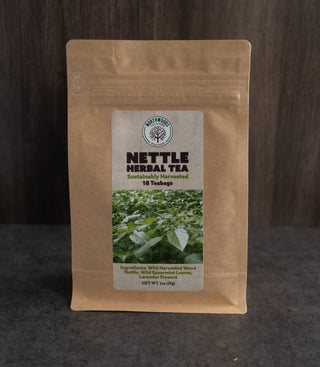
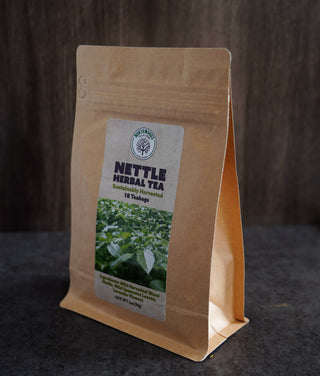
Last, we are going to talk about nettle, Urtica dioica, also known as stinging nettle or nettles. It’s incredibly mineral rich and nutrient dense so naturally it strengthens hair, nails, and bones. It’s been used to restore energy, detoxify the body, regulate blood sugar, relieve allergies, UTI’s, arthritis, and cramps. It helps with skin issues that are a result of immune activation, such as eczema or other mild rashes. There really are so many things Nettle helps with; it’s one of my most-loved herbs because of this reason.
If you’ve ever rubbed up against a Nettle plant, you know why it’s called stinging nettle. The plant has tiny needle-like structures that when they come in contact with your skin, inject a substance that creates a slight irritation. You’ll feel a slight sting and a heat sensation. It’s very uncomfortable at first, but after a few minutes it actually feels comforting in a weird hurt so good kind of way. Some people that suffer from painful arthritis find relief by using the plant in this way.
When the plant is dried or cooked, those needle-like stingers go away and are no longer irritating to touch. When we dry or cook with the plant, it's the leaves that we want, and honestly the best time to enjoy the leaves is in early spring when they are tender. You can harvest through early –mid summer, but once the plants have gone seed, you’ll want to stop using the leaves as they’ve lost a good amount of their potency. Some herbalists suggest using the seeds as a tonic for deep depletion and adrenal support. I personally have never used the plant past the point of seed so I can't really speak on this yet.

Note on the image above: sometimes the very first leaves to emerge on the nettle plant in the spring won't sting you. I would still highly recommend always wearing gloves when harvesting. Unless you want to feel the sting...
Nettle leaves as I mentioned, are nutrient-dense and mineral-rich. It is the perfect supplement post winter, especially as we are feeling depleted and dragging after a long winter. Nettle leaves pack phytonutrients, loads of calcium and magnesium, as well as iron.
If you experience seasonal allergies or flares of eczema or other rashy-skin immune responses, Nettle is a potential ally for you. It’s thought that nettle’s histamine content helps to down-regulate immune responses, combined with anti-inflammatory markers and astringent properties of the plant. Which is why many people turn to this plant for allergy relief. Find an herbalist or brand that tinctures it correctly or start drinking daily cups of tea (strong infusions) for a few weeks for best results.
Nettle has also gained the attention of researchers for its action on the symptoms and markers for people with type 2 diabetes and other chronic inflammatory diseases. Studies are pointing to the fact that Nettle provides increased antioxidant levels, greater blood sugar control, and decreased inflammatory markers for patients with type 2 diabetes that consume on a regular basis.
Nettle is a gentle diuretic that can help move stagnant fluids and support the body’s natural drainage, including the lymphatic system. It also has a slightly astringent, toning quality, which can feel supportive for some, but a bit drying for others when used in larger amounts.
I could honestly go on and on about Nettle. It’s one of those herbs that you just need to try yourself and see what action this has on restoring balance in your body and systems. You can use it as food, make it as a pesto, or sautéed with onions and garlic. You can add it to soups and sauces, or combine with other herbs as a tea. Whenever we are working with mineral rich herbs like Nettle, low and slow decoctions, using gentle heat and time to pull out the minerals and make sure the sting is no longer present.
I hope you’ve found this rundown of my favorite common springtime herbs. Whether it’s to replenish nutrients, replenish energy levels, relieve overactive immune systems, or to care for our skin, nature knows exactly what we need.




Comments (1)
Thank you Kim! This is great information to have. Hope to see you soon! Trisha